






Strong El Niño set to drive atmospheric CO₂ rise towards record levels in 2027
A strong El Niño is expected to contribute to one of the largest annual increases in atmospheric carbon dioxide ever recorded in 2027, according to a new forecast from the UK Met Office.
The annual average concentration of CO₂ at the Mauna Loa Observatory in Hawaii is projected to increase by 3.51 parts per million (ppm) next year, reaching a new record of 432.2 ppm.
The forecast increase, with an uncertainty range of 0.52 ppm, would be the largest annual rise ever projected by the Met Office and close to the record increase of 3.57 ppm recorded in 2024.
Scientists say the developing El Niño will amplify the rise by reducing the ability of natural carbon sinks, including forests, soils and oceans, to absorb carbon dioxide from the atmosphere.
El Niño is associated with changes in global weather patterns and can bring hotter and drier conditions to tropical regions, placing additional stress on vegetation and reducing the amount of CO₂ absorbed by plants.
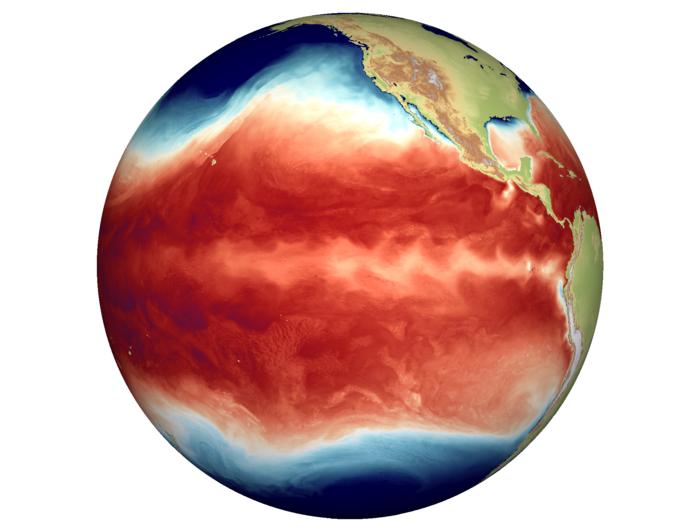
Areas at increased risk of dry conditions during the current event include Central America, parts of the western Pacific and tropical South America.
Met Office scientist Emily Wright said the strong El Niño was playing an important role in the expected increase, although human emissions remained the main driver of the long-term rise in atmospheric carbon dioxide.
Scientists also modelled what the increase would look like without the influence of El Niño. That scenario produced a projected rise of 2.57 ppm, substantially below the main forecast of 3.51 ppm.
However, even without the additional influence of El Niño, atmospheric CO₂ would continue to increase at a rate above levels consistent with limiting global warming to 1.5 degrees Celsius.
Richard Betts, Head of Climate Impacts Research at the Met Office Hadley Centre, said natural climate variability could significantly influence annual rates of carbon dioxide growth, particularly during strong El Niño events.
He said the underlying trend remained driven by human emissions and that the rate of increase would need to slow substantially to follow pathways consistent with the 1.5-degree target.
Growing gap with climate targets
The latest forecast highlights the widening gap between observed atmospheric carbon dioxide increases and pathways designed to limit global warming to 1.5 degrees Celsius.
Under the IPCC’s 1.5-degree pathways with little or no overshoot, the average annual increase in atmospheric CO₂ during the 2020s would need to range between 1.33 and 1.79 ppm.
That compares with an average increase of 2.41 ppm per year during the 2010s.
Between 2020 and 2025, the observed average increase was higher still, at 2.61 ppm annually.
The Met Office forecast suggests the rate could accelerate further in 2027 as El Niño compounds the effects of continued human-caused emissions.
The Mauna Loa Observatory has provided one of the world’s most important long-term records of atmospheric carbon dioxide since 1958.
Known as the Keeling Curve, the measurements have been maintained by the Scripps Institution of Oceanography at the University of California San Diego.
The Met Office has produced its annual carbon dioxide forecast since 2016, accounting for both human emissions and natural climate influences such as El Niño and La Niña.
Share this WeathÉire story:

