


September 2025 Confirmed as Third-Warmest Globally

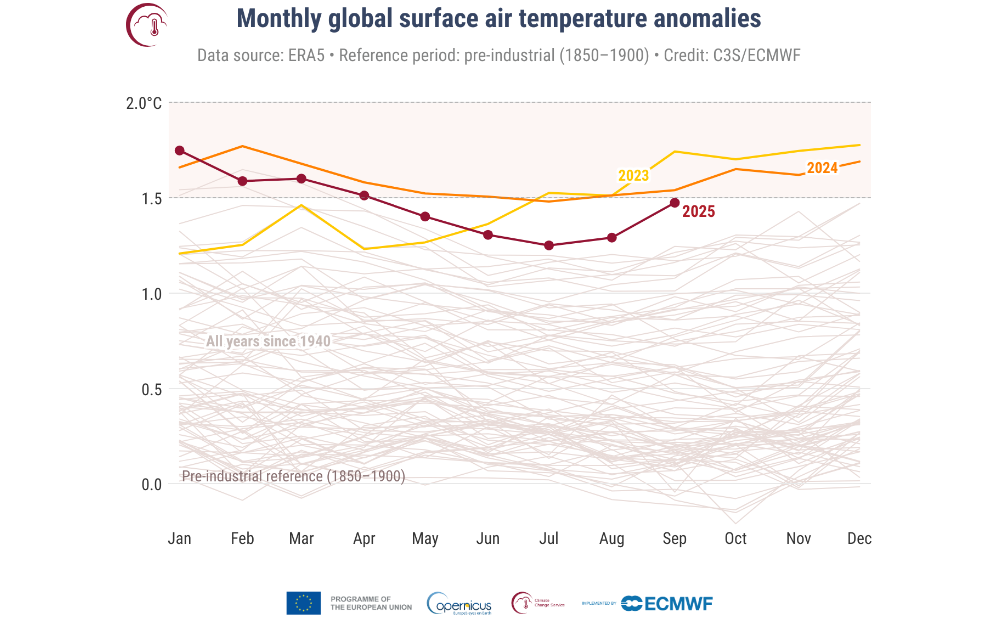
September 2025 has been confirmed as the third-warmest September on record globally, according to the latest climate bulletin from the Copernicus Climate Change Service.
The average surface air temperature reached 16.11 degrees Celsius, which is 0.66 degrees above the 1991 to 2020 climatological norm. This places it just behind the record-setting September of 2023 and marginally cooler than September 2024. Compared to the pre-industrial baseline of 1850 to 1900, last month’s global temperature was 1.47 degrees higher.
Samantha Burgess, Strategic Lead for Climate at the European Centre for Medium-Range Weather Forecasts, said the global temperature context remains largely unchanged from last year. She noted that persistently high land and sea surface temperatures continue to reflect the influence of greenhouse gas accumulation in the atmosphere.
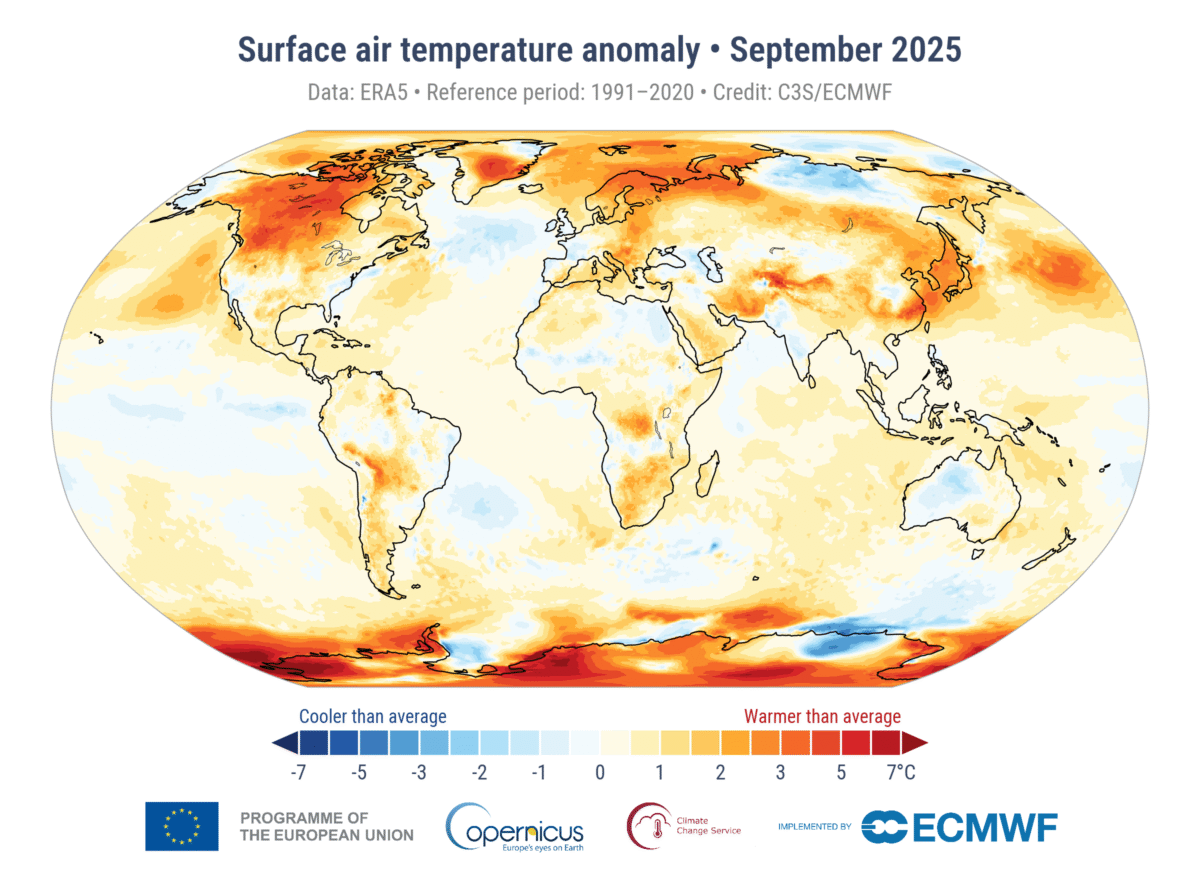
Across Europe, the average land temperature for September was 15.95 degrees, ranking fifth highest on record for the month. Fennoscandia and eastern Europe experienced the most pronounced warmth, while parts of western Europe saw slightly cooler conditions, typically less than one degree below average. Outside Europe, Canada, Greenland, northwestern Siberia and large swathes of Antarctica recorded significant temperature anomalies. Cooler-than-average conditions were limited to northern central Siberia, western Australia and parts of eastern Antarctica.
Sea surface temperatures also remained elevated. The global average SST for September was 20.72 degrees, the third-highest on record for the month. The North Pacific continued to show much-above-average temperatures, with some areas reaching record highs. In contrast, the central and eastern equatorial Pacific saw near- or below-average SSTs, consistent with ENSO-neutral conditions. Around Europe, SSTs were notably high from the Norwegian Sea to the Kara Sea, and in the Mediterranean, particularly in its western and central regions.
Arctic sea ice extent reached its 14th-lowest annual minimum in the satellite record, with the monthly extent 12 percent below average. The most significant reductions were observed north of Svalbard and Franz Josef Land and in the Beaufort Sea. Antarctic sea ice also remained low, with the daily extent marking the third-lowest annual maximum and the monthly extent ranking fourth lowest at about five percent below average. Concentrations were especially low in the Bellingshausen Sea and the Indian Ocean sector.
Hydrological patterns across Europe were mixed. Northwestern and central regions, Fennoscandia, the eastern Black Sea coast, and parts of Italy and coastal Croatia and eastern Spain experienced wetter-than-average conditions, with flooding reported in some areas. Meanwhile, the Iberian Peninsula, the Norwegian coast, peninsular Italy, the Balkans, Ukraine and western Russia were drier than usual.
Beyond Europe, heavy rainfall and flooding were reported in the southwestern and central United States, Alaska, northwestern Mexico, and parts of South America including Brazil, Argentina and Chile. Similar conditions affected the Northern Horn of Africa, the southern Arabian Peninsula, Pakistan, northwestern India, central Asia and eastern China, often linked to tropical cyclones. Drier-than-average conditions were recorded in parts of Canada, the eastern United States, northeastern Mexico, northern and eastern Russia, the northern Indian subcontinent, Uruguay and parts of Brazil.
Share this WeathÉire story: