



Five counties drive Ireland’s wind energy output
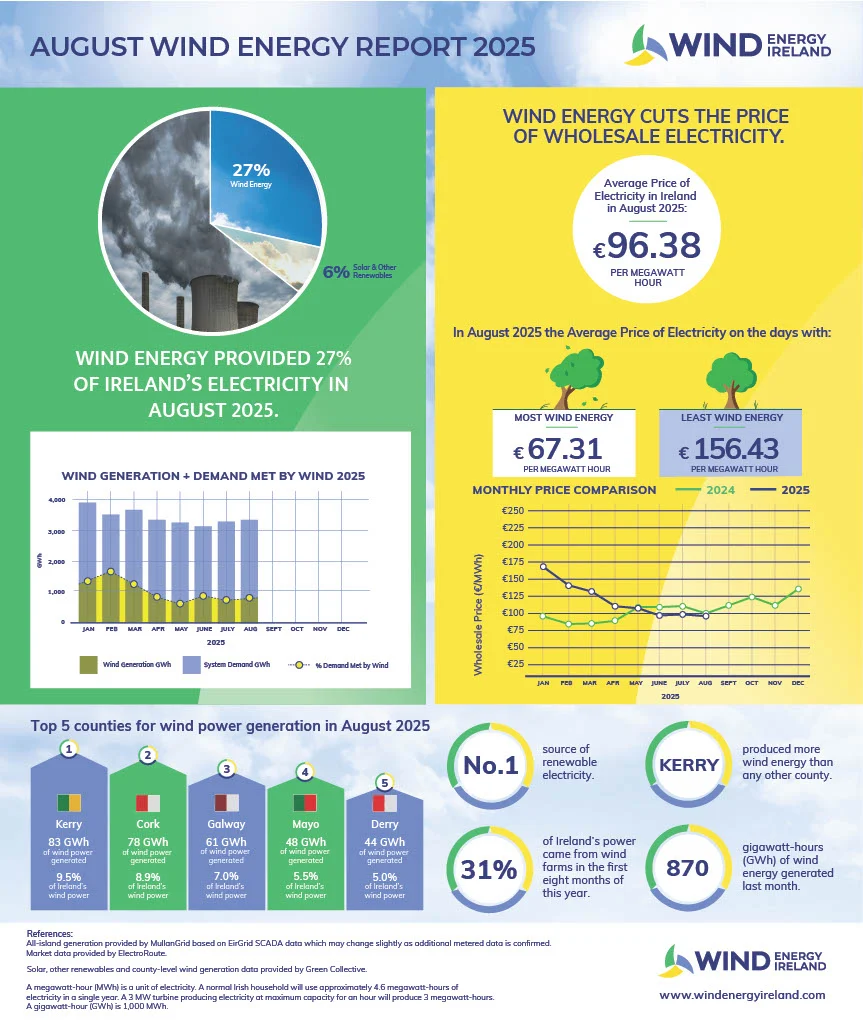
More than a quarter of Ireland’s electricity came from wind farms last month, with solar and other renewables providing an additional six per cent, according to Wind Energy Ireland (WEI).
The group’s latest monthly report shows that wind farms met 31 per cent of electricity demand over the first eight months of 2025, while Kerry reclaimed its position as the country’s leading generator.
The report also highlighted the impact of renewables on household and business costs. On the days with the highest wind generation, wholesale electricity prices fell by more than half compared with days when supply relied almost entirely on imported gas.
The average wholesale price of electricity in August was €96.38 per megawatt-hour, down 4 per cent on the same month last year. Prices fell as low as €67.31 on the windiest days, but climbed to €156.43 when fossil fuels dominated the system.
Wind generation for the month totalled 870 gigawatt-hours (GWh). Kerry produced 83 GWh, followed by Cork (78 GWh), Galway (61 GWh), Mayo (48 GWh) and Derry (44 GWh). Together, the top three counties accounted for a quarter of national wind power output.
Noel Cunniffe, chief executive of WEI, said wind was Ireland’s “number one, and most affordable, source of renewable energy”. While output fell compared with last August, he said, “wind farms have performed well since the beginning of 2025 by providing nearly a third of the country’s power”.
“The more wind energy that we can produce here in Ireland, the more we can secure our own supply of clean, affordable electricity and reduce the need to import expensive fossil fuels from other countries,” he said.
The publication of the monthly report comes alongside WEI’s pre-Budget 2026 submission, which calls for the establishment of a €100 million Climate Recruitment Fund. The proposal would provide €10 million annually over 10 years to boost staffing in planning authorities, the energy regulator and other agencies central to renewable energy development.
“Budget 2026 is an opportunity to increase capacity within State agencies and invest in the foundations of an energy independent Ireland,” Mr Cunniffe said. “That’s why we are calling for the creation of a new Climate Recruitment Fund to accelerate the transition.”
The figures in the report are based on EirGrid SCADA data compiled by MullanGrid, market data from ElectroRoute, and generation data from Green Collective.
Share this WeathÉire story: